If you have ever pulled a list of 500 target accounts from a data provider and found that 30% of the contacts came back with no email, no phone, or both, you have already encountered the core problem that waterfall enrichment solves.
The standard response is to accept the coverage gap, or to buy a second subscription and manually compare outputs. Neither is a real solution. The first wastes opportunity. The second wastes time and budget. Waterfall enrichment is the architectural answer: route each record through multiple providers in sequence, stop when you have a verified result, and pay only for what you actually get.
This article explains what waterfall enrichment is, why it works, and what it changes in practice for outbound teams.
What waterfall enrichment is
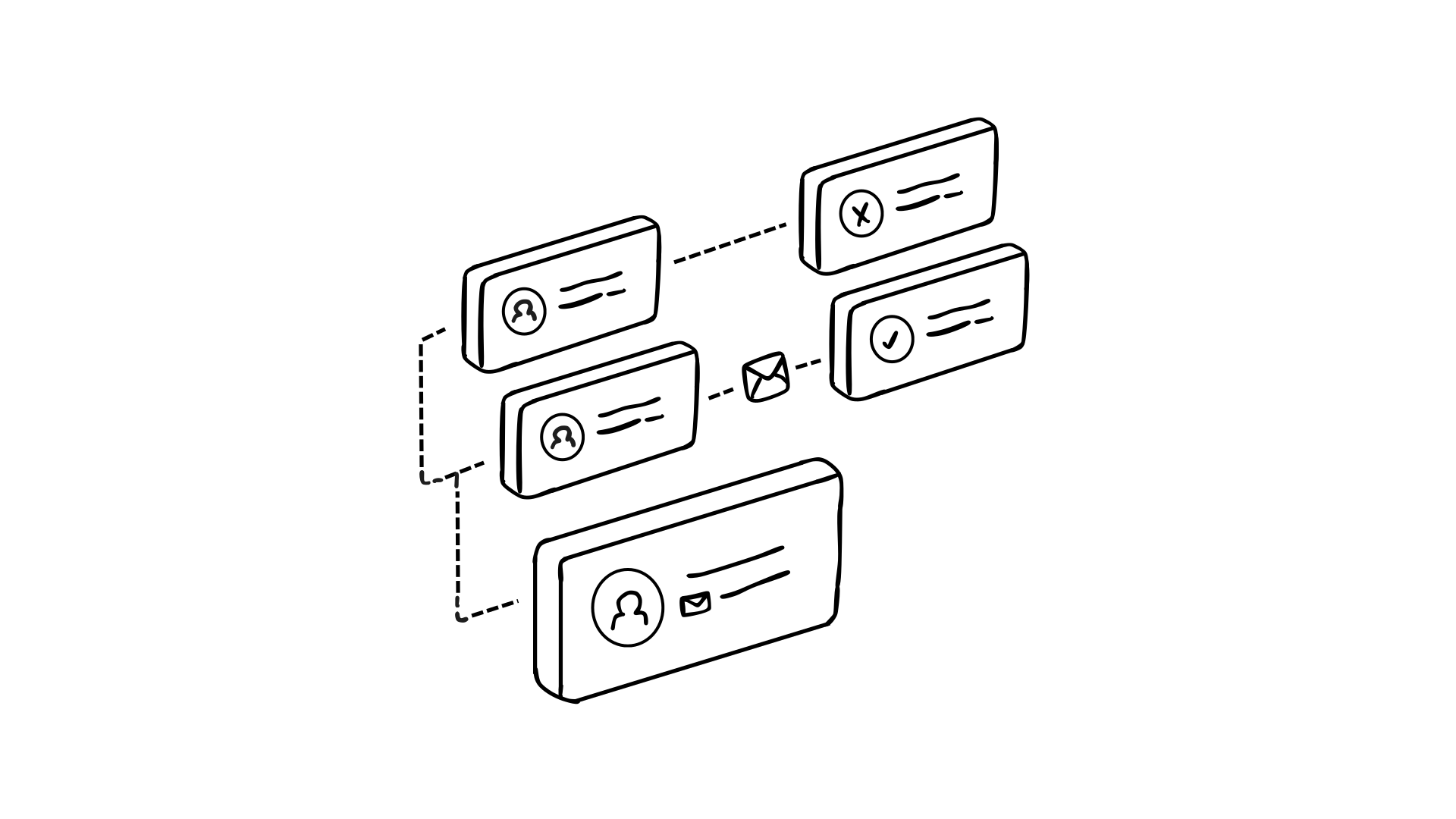
Waterfall enrichment is a sequential data lookup strategy. Instead of sending a contact record to one provider and accepting whatever comes back, you send it to a ranked list of providers, one after another, and stop the moment a verified result is returned.
The name comes from the flow of logic: data cascades down through providers like water over steps, stopping at the first step where something is found. Each provider only sees records the previous one failed to resolve.
The simplest version: you want a direct-dial phone number for a VP of Sales at a mid-sized SaaS company in Germany. You send the request to Provider A. Provider A returns nothing. The record automatically moves to Provider B. Provider B returns a mobile number. The waterfall stops. You pay for one result, not two attempts.
Why single-provider coverage fails
No B2B data provider has complete coverage. Every provider builds its database differently: some rely on LinkedIn scraping, others on email verification networks, others on phone carrier data or business registry crawls. Each approach creates blind spots.
The coverage gaps are not random. They are structural and predictable. A provider strong on US enterprise contacts may have weak coverage on European SMBs. A provider that excels at email addresses may have sparse phone data. A provider that indexed aggressively two years ago may have stale records for high-churn sectors like tech startups.
The 40% figure is not an edge case. Industry benchmarks consistently show that even the highest-coverage providers leave significant gaps on specific ICPs, geographies, and seniority levels.[1] For outbound teams targeting European markets, non-English-speaking regions, or sub-500 employee companies, single-provider coverage can fall well below 60% on phone data.[2]
The implication is straightforward: any team running outbound from a single provider is systematically leaving contacts unreachable, not because those contacts cannot be found, but because the one provider they are using does not have them.
How a waterfall is structured
A waterfall implementation has three components: a ranked provider list, a routing logic, and a verification step. Each plays a distinct role.
The ranked provider list determines which providers are queried and in what order. The ranking is not arbitrary: it reflects each provider's accuracy on your specific ICP, their cost per credit, and their latency. A provider with high accuracy and low cost belongs near the top. A provider with high recall but lower accuracy may sit further down, used as a fallback rather than a primary source.
The routing logic governs when a record moves to the next provider. In most implementations, a record advances when the previous provider returns no result, or when it returns a result that fails verification. Some implementations allow partial advancement: if Provider A returns an email but no phone, the record advances to Provider B for phone only.
The verification step sits between providers. A result from Provider A is not automatically accepted: it is checked for format validity, domain existence, and in the case of email, deliverability. Only verified results stop the waterfall. Unverified results trigger advancement to the next provider, same as a null result.
Each provider only sees records the previous one failed to resolve. Credits are consumed only when a verified result is returned.
Why provider order matters more than provider count
A common misconception about waterfall enrichment is that more providers automatically means better results. Coverage does improve with each additional provider, but the gain follows a curve: the first two or three providers capture the majority of findable contacts, and each additional provider yields diminishing returns.[3]
What matters as much as the number of providers is the order in which they are queried. The optimal ordering depends on three variables specific to your use case.
Accuracy on your ICP
Cost per verified result
Data type specialisation
Freshness and update frequency
What waterfall enrichment actually changes
For outbound teams, waterfall enrichment changes three things in practice: coverage, cost per usable contact, and deliverability.
| Metric | Single provider | Waterfall (3+ providers) |
|---|---|---|
| Phone coverage | 55–65% | Up to 93% |
| Email coverage | 65–75% | Up to 78% |
| Cost per valid contact | Higher (gaps wasted) | Lower (only pay for results) |
| Data freshness | One update cycle | Multiple refresh cycles |
| Bounce rate | Higher (unverified fills) | Lower (verification at each step) |
The coverage numbers in the table reflect real-world waterfall implementations across multiple provider stacks. The exact figures vary by ICP and geography, but the directional pattern is consistent: stacking three or more providers raises findable coverage to a range that no single provider reaches independently.[4]
The cost dynamic is counterintuitive but important. Because waterfall enrichment only charges for verified results, not for failed attempts, the effective cost per usable contact is often lower than single-provider pricing even when the list-price cost per credit is identical. You stop paying for the 30 to 40% of queries that come back empty.
What to look for in a waterfall implementation
Not all waterfall implementations are equivalent. When evaluating whether a tool genuinely implements waterfall logic, or simply batches multiple providers and returns the first alphabetically, four things distinguish the real from the superficial.
Configurable provider ordering. You should be able to rank providers based on your own data, not a default sequence chosen by the vendor. A vendor who ranks their own primary provider first regardless of your ICP performance data is not giving you a real waterfall.
Verification at each step. The waterfall should only stop when a result passes verification, not when any result is returned. This distinction matters: a provider returning a syntactically valid email that bounces is not a successful result.
Credit consumption transparency. You should be able to see which provider resolved each record, how many providers were queried before a result was found, and what the per-record cost breakdown was. Without this, you cannot optimise provider ordering over time.
Partial resolution logic. A contact record has multiple fields: email, mobile, direct dial, LinkedIn URL, title, seniority. A sophisticated waterfall does not treat the record as binary. If Provider A resolves the email but not the phone, the record should advance to Provider B for phone only, not be marked as complete.
Teams that implement waterfall enrichment correctly report consistent improvements in reply rates, lower bounce rates, and higher SDR productivity, because their sequences reach real people at current contact details rather than addresses that were valid six months ago at a company someone has since left.[5]
The concept is simple. The implementation quality is what separates a genuine coverage improvement from a marketing claim.